
IBN ARABI CENTRE OF METAPHYSICS & PHILOSOPHY
Ibn ʿArabi, also known as Shaikh al-Akbar Muhyi al-Din Ibn al-Arabi(1165 – 1240), was an Andalusian Muslim scholar, mystic, poet, and philosopher. He was and still remains extremely influential within Islamic thought. His cosmological teachings became the dominant worldview in many parts of the Muslim world.
The Centre focuses on study and research programs on traditional Islamic spirituality - Sufism / Tasawwuf - including theoretical Sufism, Sufi Poetry/Kalaam; Symbolism and Comparative Mysticism; traditional Islamic philosophy, its major teachers and themes, as well as comparative philosophy, and the intellectual heritage of the Islamic World in general.
Programs/Courses
-
Part 1: A modular study program inspired by the Quranic verse ‘He giveth wisdom unto whom He will, and he unto whom wisdom is given, he truly hath received abundant good. But none remember except men of understanding. Al- Quran 2:269 Al-Baqara’ covering aspects of Modernity, and the Islamic Tradition with a focus on South Asia.
Part 11: A modular program covering six foundational subjects as Philosophy, Metaphysics, Sprituality, Rhetoric/Balaghat, Intellectual Tradition & Masnavi.
-
Islamic Philosophy, with Emphasis on Mulla Sadra's Hikmat al-Muta'aliyah
A modular (4) study program on the introduction to Islamic Philosophy based on the book Bidayat al-Hikmah (with supplementary papers/handbooks) & Hikmat e Sadra - An Introduction to Islamic Philosophy by Ustad Hamid Reza Fazil (Published by Hast-o-Neest).
Bidāyah al-Ḥikmah (The Elements of Islamic Metaphysics) is a foundational, concise textbook on Islamic philosophy and metaphysics written by Allamah Sayyid Muhammad Husayn Tabatabai.
-
The one-month - 12 sessions - Quran Introductory Program is designed to take the ritualistic relationship with the Quran to a more holistic and intellectual level. The program aims to achieve this by opening doors for the participant towards the following aspects:
(1) Appreciating the language and socio-historical context of the Quranic revelation.
(2) Experiencing the Quran in its visual, auditory & aesthetic dimensions.
(3) Familiarization with the mainstream theological schools and the classical methodologies of interpretation to bring out the contrast with contemporary trends.
(4) Taking cognizance of the layers of meaning and themes of the Quran.
(5) Introducing other aspects of the Quran such as its connection with hadith; methods of transmission; the impact of the Quran on Islamic Culture and Civilization; and its usage as talismanic power, and more.
1. In Search of Wisdom in the Modern Age. Foundations - Part 1
تلاشِ حکمت دورِ حاضر کے تناظر میں
A modular program, the journey of In Search of Wisdom in the Modern Age consists of study and reflection on Six Topics or Modules of 6 weeks each - a total of 12 sessions per module (where each module is announced separately).
These conversations include lectures, seminars & demonstrations, and generally require intensive reading and presentations from participants.
Sessions are online & in-person, twice a week on weekends. Applicants can participate in all the six modules or select a module as per interest.
Topics/Modules
-
An Overview of the History, Principles and Development of the Modern Age.
-
Islamic Worldview - Metaphysics, Cosmology, Epistemology, Ethics & Politics
-
Mysticism - Theoretical & Practical Aspects
-
The Function, Principles & Practice of Traditional Islamic Art & Architecture - This course introduces participants to the Philosophy, World-view, Principles & Practice of Traditional (Pre-Modern) Art in general and the Islamic Arts of the Subcontinent in Particular.
-
In Arabic, Persian and Urdu Adab refers to prescribed Islamic etiquette - "refinement, good manners, morals, decorum, decency, humaneness" – as well as Literature.
-
This course introduces participants to the major aspects of the Islamic intellectual tradition of the Subcontinent. In this course we will discuss the Muslim Intellectuals and Islamic literatures of Early Muslim, Sultanate and Mughal Periods. Our goal is to understand the concepts that Muslim intellectuals articulated and the intellectual movements of Ma’qulaat (Rational Sciences), Manqulaat (Religious Sciences) and Tasawwuf (Islamic Spirituality) engendered from the 8th century through the 18th century. We will also explore questions concerning academic decentralization, transmission of knowledge and pattern of education in Subcontinent.
Module Outline
-
1. Modernity
An Overview of the History, Principles and Development of the Modern Age.
i. Greco-Roman Roots 2 Sessions
ii. Renaissance 2 Sessions
iii. Enlightenment 2 Sessions
iv. Scientific Revolution 2 Sessions
v. Industrial Revolution 2 Sessions
vi. Modernity & Post-Modernity 2 Sessions
-
Starts on 5th April 2024
1. Introduction
Taimoor K. Mumtaz
2. Metaphysics
Taimoor K. Mumtaz
3. Cosmology
Taimoor K. Mumtaz
4. On Knowledge – God, Man & Cosmos
Hamid Raza Fazil
5. Ethics – I
Syed Rizwan Zamir
6. Ethics – II
Syed Rizwan Zamir
7. Ethics - III
Syed Rizwan Zamir
8. Student Presentations 1 session
-
Taimoor Khan Mumtaz & Dr. Syed Rehan Gelani
1. Introduction - Nizami Bansari
2. Book of Certainity – Abu Bakr Siraj ad-Din
3. Haal-e-Safar – Bagh Hussain Kamal
4. Quran, Hadith & Spirituality
5. Awarif-ul-Maarif – Shaykh Umar Shahabuddin Suhrawardi
6. Ayn-ul-Faqr – Hazrat Sultan Bahu
7. Fuyuz-ul-Haramayn – Shah Waliullah -Knowledge through Unveiling – Mukashafa
8. Comparative Mystical Practice
9. Maqabees al-Majalis & Divan - Khwaja Ghulam Farid
(Wahadat al-Wujud)
10. Mahasin al-Majalis – Ibn al-Arif
11. Student Presentations
-
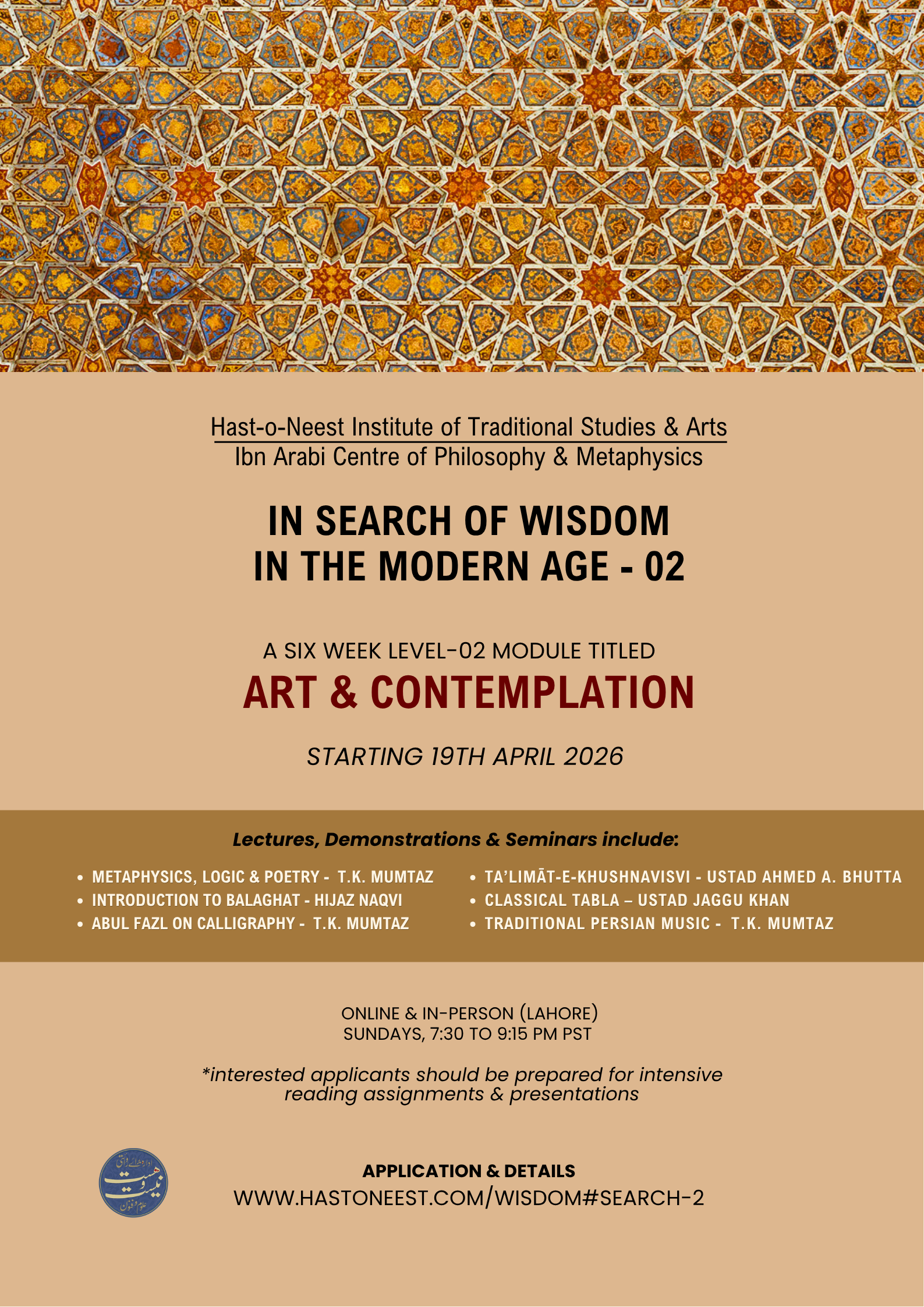
4. Art & Contemplation
The Function, Principles & Practice of Traditional Islamic Art & Architecture
This course introduces participants to the Philosophy, World-view, Principles & Practice of Traditional (Pre-Modern) Art in general and the Islamic Arts of the Subcontinent in Particular.
1. Geometry, Cosmology & Number (Demo)
Taimoor K. Mumtaz
2. Traditional Art – Haqeeqat Aur Majaaz
Taimoor K. Mumtaz
3. Seminar: ‘Art of Islam’ (Book) - Taimoor Khan Mumtaz
4. Seminar: ‘The World of Imagination & the Concept of Space in the Persian Miniature’ – S. H. Nasr - Fyza Noon
5. Meter (Uruz) in Urdu Poetry - Syed Hijaz Naqvi
6. Hindustani Classical Music (Talk/Demo) - Ustad Chand Khan
7. Calligraphy (Talk/Demo) - Ustad Ahmed Ali Bhutta
8. Grammar, Vocabulary & Methods of Mughal Architecture - Taimoor K. Mumtaz
9. Aesthetic Theory – The Nav Rasa (Nine Rasas) - Natyashastra (Bharatmuni)
Taimoor K. Mumtaz
10.
11. Wazir Khan Mosque – A Mirror of Civilisation (Site Visit)
Taimoor K. Mumtaz
12. Student Presentations
-
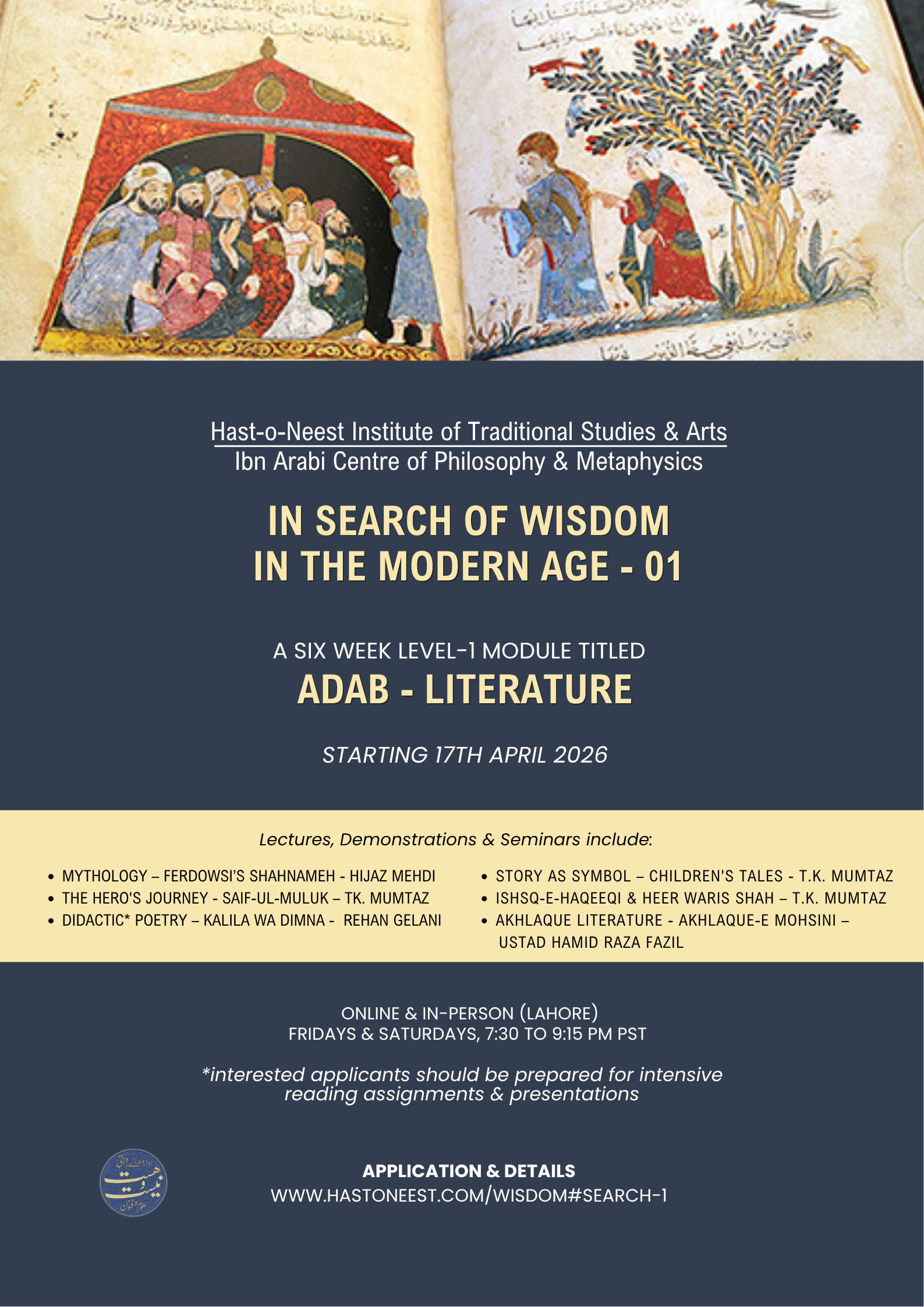
In Arabic, Persian and Urdu Adab refers to prescribed Islamic etiquette - "refinement, good manners, morals, decorum, decency, humaneness" – as well as Literature.
Orientation – The Place of Adab in Muslim Civilisation - Dr. Syed Rizwan Zamir
2. Mythology - From The Shahnama of Ferdowsi - Syed Hijaz Naqvi
3. Story as Symbol - Children’s Tales - Taimoor K Mumtaz
4. The Hero's Journey - Saif ul Mulook of Mian Muhammad Bakhsh - Taimoor K Mumtaz
5. Akhlaque Literature - Akhlaque-e Mohsini – Agha Hamid Raza Fazil
6. The Symbolism of Love - Ishq e Haqeeqi & Heer Waris Shah - Taimoor K Mumtaz
7. Didactic* Poetry & Prose – Gulistan of Sheikh Saadi - Dr. Qaiser Shahzad
8. Didactic* Poetry & Prose - Kalila wa Dimna - Dr. Syed Rehan ul-Hassan Gelani
9. Spiritual Development - Masnavi Maulana Rum – Afira Khan
10. Sacred Literature - Selections from Mahabharata & Ramayan – Dr. Shahid Rasheed
11. Student Presentations
-
Introduction to the Intellectual Tradition of Islamic South Asia with Dr. Amjad Waheed
بر صغیر کی اسلامی فکری روایت
Week-wise Outline:
Week 1: Islamic Intellectual Tradition in Pre Mughal South Asia: Abu Ali Sindhi and Amir Khusru
Week 2: Intellectual and Scholarly Networks in Mughal India: Fatehullah Shirazi and Muhib ullah Illahabadi
Week 3: Islamic Intellectual Culture in Mughal India:Chahar Chaman by Chanderbhan Brehman
Week 4: Unity of Existence in the Light of Mulla Abdul Ali Lakhnavi’s Treatise
Week 5: Unity of Witnessing in the Light of Sheikh Ahmed Sirhindi’s Maktubat
Week 6: Education in Mughal South Asia: Farangi Mahal and Risalah Danishmandi
(For application criterea, method please see the tab titled ‘Application’)
(For structure and fee, please see the tab titled ‘Structure & Fee’)
Structure
-
Teacher Profiles
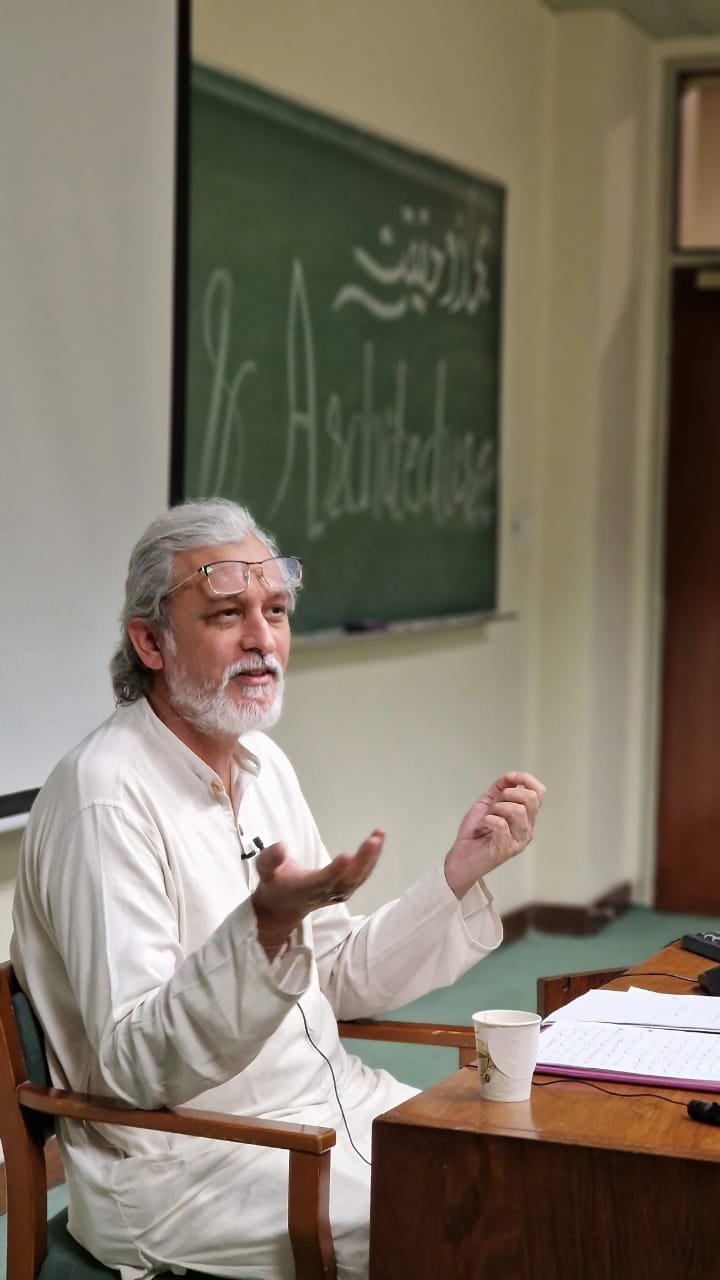
Taimoor Khan Mumtaz: MA PRASADA, Leicester, UK; BArch NCA Lahore. Taimoor Khan Mumtaz practices architecture in Lahore, and teaches metaphysics, geometry and Islamic Architecture at Hastoneest and various other institutes.
Syed Hijaz Mehdi is a poet and teaches Urdu poetry appreciation at Hast o Neest, and other educational forums. He is fluent in Arabic, Farsi and holds a keen interest in philosophy. He has published a collection of his poetry, and a book on Urdu poetics published by Hast o Neest.
Hamid Reza Fazil: A traditional religious scholar of Arabic, Quranic Exegesis and Islamic Law with special interest in philosophy & metaphysics. Listen to a Lecture
Dr. Syed Rizwan Zamir: Ph.D. University of Virginia. B.A . James Madison University. Area of Islamic studies, specializing in Islamic thought and spirituality. He is currently an Associate Professor at Davidson College, NC, USA.
Dr. Amjad Waheed: Ph.D.Comparative Civilizations University of Punjab. Ex - Director School of Advanced Studies, UMT, Lahore.
Fyza Noon: NCA Fine Arts * Miniature Painting under Ustad Bashir Ahmed.
Ustad Chand Khan: Patiala & Sham Churasi Gharanas, sons of the famous Ustad Hussain Bukhsh Gullu
Ustad Ahmed Ali Bhutta: Khattat Ahmed Ali Bhutta's teacher is Hafiz Muhammad Yousuf Sadeedi. He is from Faisalabad, and his expertise is in Nastaaliq, Naskh, Thuluth, Kufic scripts. He has participated in several calligraphy competitions and has been a part of the Hast-o-Neest calligraphy exhibition Darya Ba Hubab Andar at Koel Gallery, Karachi.
-
Program Requirement
1 | Applicants should be comfortable with Urdu and English language.
2. Applicants should be prepared to give at least 3 hours for reading in a week.
3.Participants will be required to give presentations on selected conversations & reading.
The emphasis is on reading, reflection & teacher engagement to gain clarity & insight
-
Course Structure:
1) Format: Online on Zoom & In-person
Two 45 minutes sessions with a 15 minute break on Fridays & Saturdays | 7:30 pm to 9: 15 pm.
2) Duration: One module is for Six Weeks - Total 12 sessions per module.
3) Contributing Fee per Module - PKR 9,000/-
Details of payment method will be shared after student application.
-
The sessions will be online on Zoom & In person.
Recordings of sessions will be provided to all applicants either as downloadable Zoom link or You Tube upload.
-
To Apply: Send in Course Title, Applicant Name, Academic Background, Email Address & Whatsapp number on hast.o.neest@gmail.com or on 03008493170 with a short paragraph on the reason for applying.
Fee Guidelines will be provided.

‘He giveth wisdom unto whom He will, and he unto whom wisdom is given, he truly hath received abundant good. But none remember except men of understanding.’
2:269 Al-Baqara
In Search of Wisdom in the Modern Age. Seminars - Part II
تلاشِ حکمت دورِ حاضر کے تناظر میں
A modular program, the journey of In Search of Wisdom in the Modern Age consists of study and reflection on Six Topics or Modules of 6 weeks each - a total of 12 sessions per module (where each module is announced separately).
These conversations are primarily seminar based where select classical texts are read extensively, and may require presentations from participants.
Sessions are online & in-person, once a week on weekends. Applicants can participate in all the six modules or select a module as per interest.
Module Outline
-
1. Modernity
An Overview of the History, Principles and Development of the Modern Age
Philosophical Foundations: Reign of Quantity – Guenon Study Circle - 6 Sessions - Dr. Syed Abbas Zilqarnain
Critique of Science: Wolfgang Smith - Study Circle - 6 Sessions Dr. Syed Abbas Zilqarnain
-
2. Islamic Worldview
Metaphysics, Cosmology, Epistemology, Ethics & Politics
Metaphysics: Muqaddama-e-Qaiseri Study Circle - 3 Sessions Hamid Raza Fazil
Cosmology: Ibn Sina’s Shifa Study Circle - 3 Sessions Hamid Raza Fazil
Epistemology: Allama Tabatabi Text Study Circle - 3 Sessions Hamid Raza Fazil
Ethics: Akhlaq-e-Nasiri OR Tehzib al-Akhlaq Study Circle - 3 Sessions Dr. Syed Rizwan Zamir
-
3. Mysticism
Theoretical & Practical Aspects | Total 12 sessions - 6 Weeks | Study Circles on Three Texts
Starting 7th December 2024
Awarif al-Ma’rif of Shahabuddin Suharwardy | 4 Sessions - Dr. Syed Rehan Gelani
Altaf al Quds of Shah Waliullah 4 Sessions - Taimoor Khan. Mumtaz
The Book of Certainty of Dr. Martin Lings Abu Bakr Siraj ud Din - 4 Sessions - Taimoor Khan Mumtaz
Complete Module Contributing Fee is PKR 9000/- The method of payment is provided to applicants.
For the Application Method please see the Application Tab.
-
4. Art & Contemplation
The Function, Principles & Practice of Traditional Art & Architecture
‘Metaphysics, Logic & Poetry in the Orient’ - S. H. Nasr Study Circle - 1 Session Taimoor K. Mumtaz
‘Nazm-e-Parveen - Study Circle - 1 Session Ustad Ahmed Ali Bhutta
Ta’limāt-e-Khushnavisi Maa’ Qavāid’(1901) by Munshi Shamsuddin Aijaz Raqam Lakhnavi
Abul Fazlon Calligraphy in Ain-e-Akbari (1590) Study Circle - 1 Session Taimoor K. Mumtaz
Mir Ali Tabrizi’s Introduction to his 16th C Treatise on Calligraphy
‘Ustad Ahmed Mimar Lahori Study Circle - 1 Session Taimoor K. Mumtaz
Aur Uska Khandan’ (1957) 40 Page Monograph by Dr. Abdullah Chughtai
Urdu Shayari Study Circle - 2 Sessions Syed Hijaz Mehdi
Introduction to Balaghat Study Circle - 2 Sessions Syed Hijaz Mehdi
‘The Influence of Sufism on Traditional Persian Music’ S. H. Nasr Study Circle - 1 Session Taimoor K. Mumtaz
Classical Music Vocal Demo Chand Khan
Classical Tabla Tabla Demo Ustad Jaggu
Calligraphy Demo Ahmed Ai Bhutta
-
5. Adab & the Search for Wisdom
- Masnavi Maulana Rum Study Circle - 3 Sessions Kauser Ali
- Saif-ul-Muluk - Mian Muhammad Bukhsh Study Circle - 3 Sessions Taimoor K. Mumtaz
-Sub Ras – Allegorical Tale - Mullah Wajih Deccan Study Circle - 3 Sessions Taimoor K. Mumtaz
-Heer of Waris Shah Study Circle - 3 Sessions Taimoor K. Mumtaz
-
6. The Islamic Intellectual Tradition
Meaning, Purpose & Transmission of Knowledge (with Focus on the Sub-Continent)
- Hujatullah al-Baligha - Shah Waliullah Study Circle - 6 Sessions Dr. Amjad Waheed
- Millat-e-Islamia: Tehzeeb-o-Taqdeer - Siraj Munir Study Circle - 6 Sessions Dr. Amjad Waheed
Structure
-
Teacher Profiles
Taimoor Khan Mumtaz: MA PRASADA, Leicester, UK; BArch NCA Lahore. Taimoor Khan Mumtaz practices architecture in Lahore, and teaches metaphysics, geometry and Islamic Architecture at Hastoneest and various other institutes.
Syed Hijaz Mehdi is a poet and teaches Urdu poetry appreciation at Hast o Neest, and other educational forums. He is fluent in Arabic, Farsi and holds a keen interest in philosophy. He has published a collection of his poetry, and a book on Urdu poetics published by Hast o Neest.
Dr. Syed Abbas Z Naqvi | is an Associate Professor of Engineering at University of Engineering & Technology, Lahore. He obtained his PhD from Purdue University, USA, in Computer Sciences. His research areas include: Sparse bayesian learning, Object recognition, Collaborative robots & deep learning.
Hamid Reza Fazil: A traditional religious scholar of Arabic, Quranic Exegesis and Islamic Law with special interest in philosophy & metaphysics. Listen to a Lecture
Dr. Syed Rizwan Zamir: Ph.D. University of Virginia. B.A . James Madison University. Area of Islamic studies, specializing in Islamic thought and spirituality. He is currently an Associate Professor at Davidson College, NC, USA.
Dr. Amjad Waheed: Ph.D.Comparative Civilizations University of Punjab. Ex - Director School of Advanced Studies, UMT, Lahore.
Kausar Ali
Kausar Ali - as a student of Farsi - has been reading Masnavi for more than ten years under the guidance of various teachers.
-
Program Requirement
1 | Applicant should preferably have completed the same module in In Search of Wisdom Part 1, or participated in any other related study program at Hast o Neest
2 | Applicant should be comfortable with Urdu and English language.
2. Applicants should be prepared to give at least 5 hours for reading & reflection in a week.
The emphasis is on reading, reflection & teacher engagement to gain clarity & insight
-
Course Format & Duration:
1) Format: Online on Zoom & In-person
One hour & 45 minutes session with a 15 minute break on Sundays | 7:30 pm to 9:15 pm
2) Duration: Six Weeks for one module.
3) Contributing Fee per Module | PKR 9, 000/-
Details of payment method will be shared after student application.
-
The sessions will be online on Zoom & In person.
Recordings of sessions will be provided to all applicants either as downloadable Zoom link or You Tube upload.
-
To Apply: Send in Course Title, Applicant Name, Academic Background, Email Address & Whatsapp number on hast.o.neest@gmail.com or on 03008493170 with a short paragraph on the reason for applying.
Fee Guidelines will be provided.
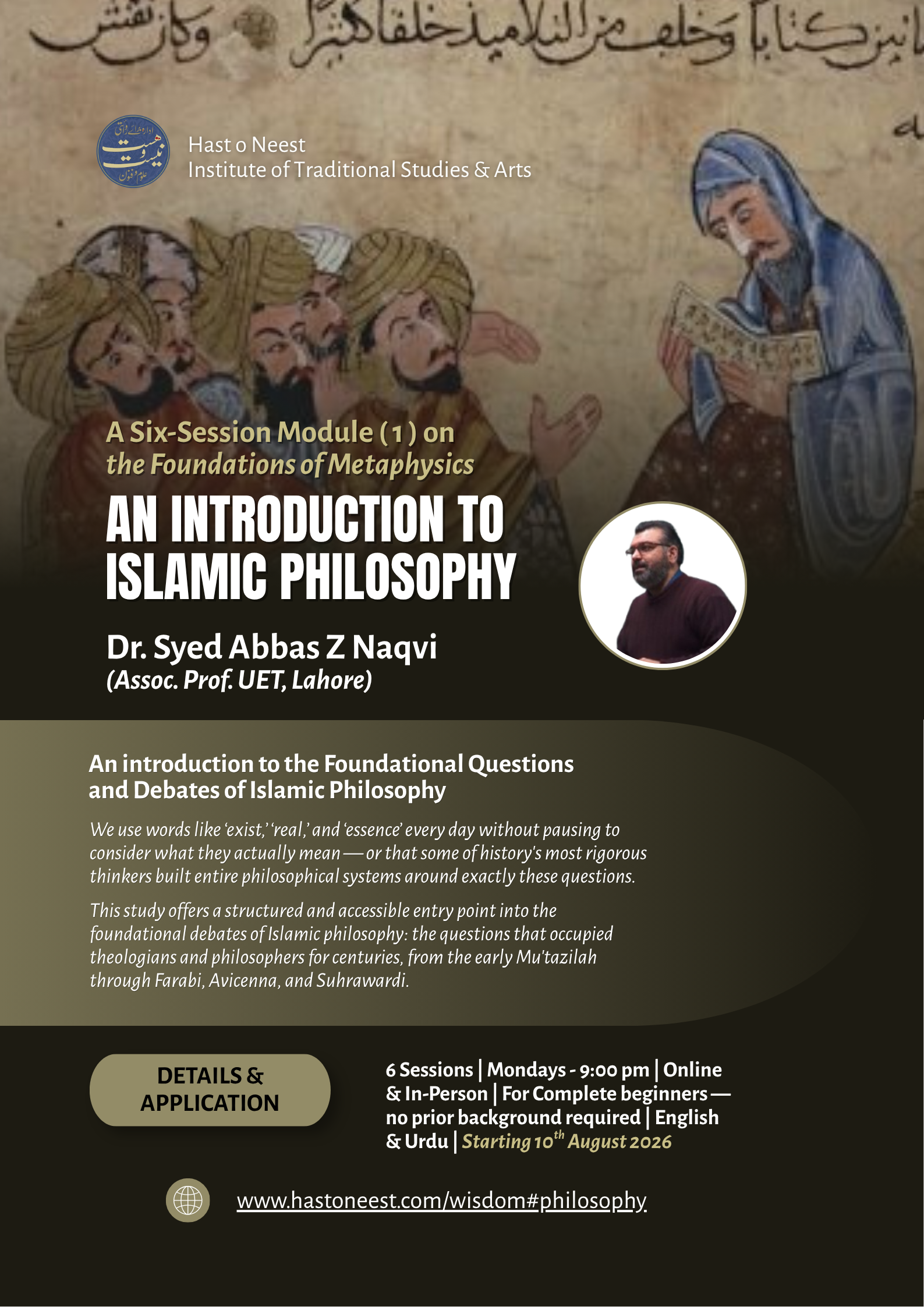
2. Islamic Philosophy with Emphasis on Mulla Sadra's Hikmat al-Muta'aliyah
A modular study program designed for complete beginners to the world of philosophy by Dr. Syed Abbas Z Naqvi.
The first module - Introduction to Islamic Philosophy begins on 10th August 2026.
Words like ‘exist,’ ‘real,’ and ‘essence’ are used every day, without pausing to consider what they actually mean — or that some of history's most rigorous thinkers built entire philosophical systems around exactly these questions.
This modular study program offers a structured and accessible entry point into the foundational debates of Islamic philosophy: the questions that occupied theologians and philosophers for centuries, from the early Mu'tazilah through Farabi, Avicenna, and Suhrawardi.
The initial module provides an overview of the philosophical tradition and the placement and thoughts of Mulla Sadra on Ilahiat within that tradition.
The full syllabus (25 sessions) is divided into four modules (weekly sessions):
I | Foundations of Metaphysics (6 sessions)
II | Sadrian Ontology (6 sessions)
III | Motion and Cosmology (5 sessions)
IV | Epistemology and Synthesis (8 sessions)
“اسلامی فلسفہ صدیوں سے اسلامی علمی روایت کا ایک اہم جز اور ستون رہا ہے - چنانچہ درس نظامی کے نصاب میں منطق اور دیگر علوم عقلیات کے زمرے میں شامل رہا ہے - علامہ محمد اقبال کی پی ایچ ڈی مقالے میں اقبال ملا صدرا کا ذکر کرتے ہیں -”
Dr. Syed Rizwan Zamir, Preface, 'Hikmat-e-Sadra'
Outline & Structure
-
Islamic Philosophy, with Emphasis on Mulla Sadra's Hikmat al-Muta'aliyah
A four module program of a total of 25 sessions spanning the world of Islamic Philosophy - for complete beginners to the subject - by Dr. Syed Abbas Z Naqvi.
Total Sessions - 25
Modules - 4
Primary Text - Bidayat al-Hikmah (with supplementary papers/handbooks)
Module Titles:
I - Foundations of Metaphysics (6)
II - Sadrian Ontology (6 sessions)
III - Motion and Cosmology (5)
IV Epistemology and Synthesis (8)
Primary Texts:
Bidāyah al-Ḥikmah (The Elements of Islamic Metaphysics) is a foundational, concise textbook on Islamic philosophy and metaphysics written by Allamah Sayyid Muhammad Husayn Tabatabai.
Hikmat e Sadra - An Introduction to Islamic Philosophy by Ustad Hamid Reza Fazil (Published by Hast-o-Neest).
-
Across six sessions of the first Module, the study follows a single line of reasoning — from the most basic question in philosophy (what does it mean to be?) to one of the central debates that has shaped Islamic metaphysics for centuries.
The sessions are sequenced so that each builds the vocabulary and concepts required for the next.
Session 1: Introduction to Metaphysics- What is metaphysics?- Being qua being- Subject of metaphysics- Metaphysics as a discipline: the Aristotelian starting point An orientation to the discipline: what it means to study ‘being’ as such, and why this question has occupied philosophers for millennia.
Session 2: Essence and Existence- Why distinguish essence from existence?- Essence in itself- The unicorn example- The horse example- External existence- Mental existence (first introduction)- One essence, multiple modes of existence- Why mental existence does not mean ‘imaginary’ The central session of the module. Participants come to see how a single essence — ‘horse,’ for instance — can be said to exist in more than one way.
Session 3: The Three Domains of Being- External existence- Mental existence- The domain of factuality (nafs al-amr) — kept accessible A concise, non-technical survey of the three domains in which something can be said to be real, building directly on Session 2.
Session 4: Historical Development- Mu’tazilah- Farabi- Avicenna- Suhrawardi Having established the underlying problem, participants are now introduced to the thinkers who engaged with it across the history of Islamic thought.
Session 5: Avicenna's Ontology- Bridge: how essence and existence become necessity and contingency- Necessity- Contingency- Causality- Possible beings- Necessary Being An examination of how Avicenna develops the essence/existence distinction into a rigorous argument concerning necessity, contingency, and the Necessary Being.
Session 6: The Primacy Debate: Essence or Existence?- Suhrawardi- Asalat al-Mahiyyah (primacy of essence)- Asalat al-Wujud (primacy of existence)- Closing synthesis: the whole journey in one picture The concluding session addresses one of the central fault lines in Islamic metaphysics: whether essence or existence is more fundamentally real. The session closes with a brief synthesis connecting each of the preceding five sessions into a single line of argument.
-
The study program is intended for
Anyone with a genuine interest in philosophical inquiry and no assumption of prior study.
Students, teachers, and seminary participants seeking a firmer grounding before continuing further; and any adult with a sustained interest in the foundational questions of Islamic philosophy.
No prior background in philosophy, logic, Arabic, or Persian is required.
Comfort following instruction in a mix of English and Urdu.
Participants with some prior background in philosophy or kalam are also welcome; the pace, however, is set for those encountering this material for the first time
-
Participant requirements:
Comfortable with Urdu and English language
• Attendance at all six sessions, as each builds directly on the one before it.
• A willingness to ask questions and engage in discussion.
Structure.
Pace: one session per week, over six weeks, allowing sufficient time between sessions for the material to be absorbed.
Mondays, 9:00 pm (to 10:00/10:30 pm) - Online on Zoom & in-person at Hast-o-Neest Lahore - starting 10th August 2026.
Recordings of sessions will be provided to applicants.
Thecontributing fee for Module 1 is PKR 7,500/-
Applicants will be provided with the method of payment.
-
Dr. Syed Abbas Z Naqvi | is an Associate Professor of Engineering at University of Engineering & Technology, Lahore. He obtained his PhD from Purdue University, USA, in Computer Sciences. His research areas include: Sparse bayesian learning, Object recognition, Collaborative robots & deep learning.
-
Mulla Sadra (c. 1571–1640) was a pivotal philosopher. His Ilahiyat (metaphysics/theology) represents a massive synthesis of Peripatetic philosophy, Illuminationist philosophy, Sufi metaphysics, and scriptural sources.
ملا صدرا 17ویں صدی کے مشہور فلسفی، صوفی اور "حکمت متعالیہ" کے بانی تھے۔ انہوں نے فلسفہ، عرفان، اور کلام کو یکجا کر کے "وجود" (Existence) کو بنیاد بنایا، جس میں وجود کی حقیقت (اصالت الوجود) اور اس کی تدریجی حرکت (حرکت جوهری) مرکزی نظریات ہیں۔
The book Hikmat e Sadra - An Introduction to Islamic Philosophy by Ustad Hamid Reza Fazil was published by Hast o Neest in 2021.
“اسلامی فلسفہ صدیوں سے اسلامی علمی روایت کا ایک اہم جز اور ستون رہا ہے - چنانچہ درس نظامی کے نصاب میں منطق اور دیگر علوم عقلیات کے زمرے میں شامل رہا ہے - علامہ محمد اقبال کی پی ایچ ڈی مقالے میں اقبال ملا صدرا کا ذکر کرتے ہیں -” Dr. Syed Rizwan Zamir
-
To Apply:
نام، تعلیم، پیشہ اور فلسفہ میں دلچسپی کی تفصیلات مندرجہ ذیل پتہ پہ ارسال کر دیں ۔
Send Name, Profession, Academic Background, Whatsapp Number and a brief statement on the reason for applying to hast.o.neest@gmail.com or on 0300 8493170.

Dr. Amjad Waheed

Hamid Reza Fazil
Syed Hijaz Mehdi Naqvi

Dr. Syed Rehan Gelani
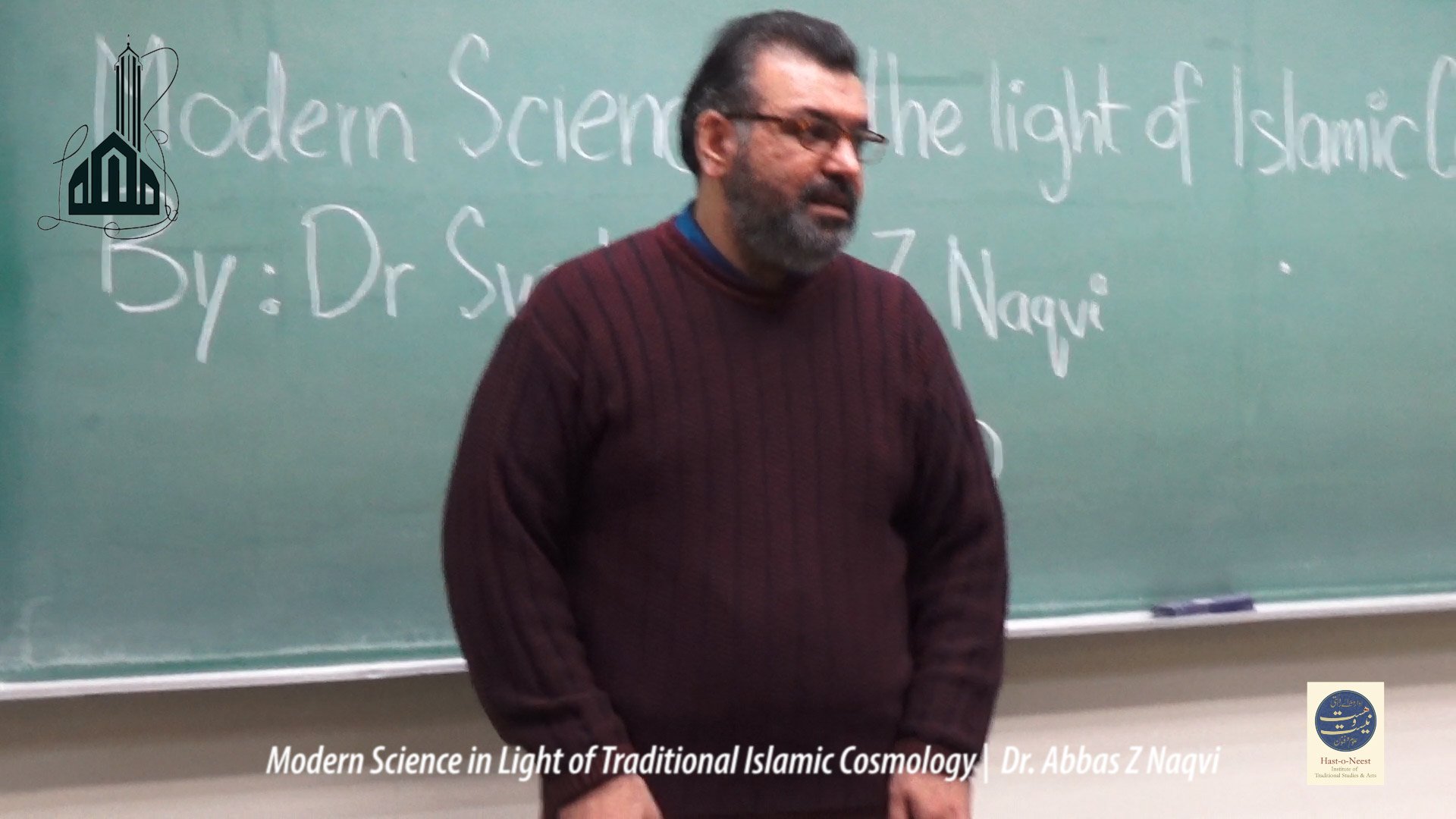
Dr. Syed Abbas Z Naqvi
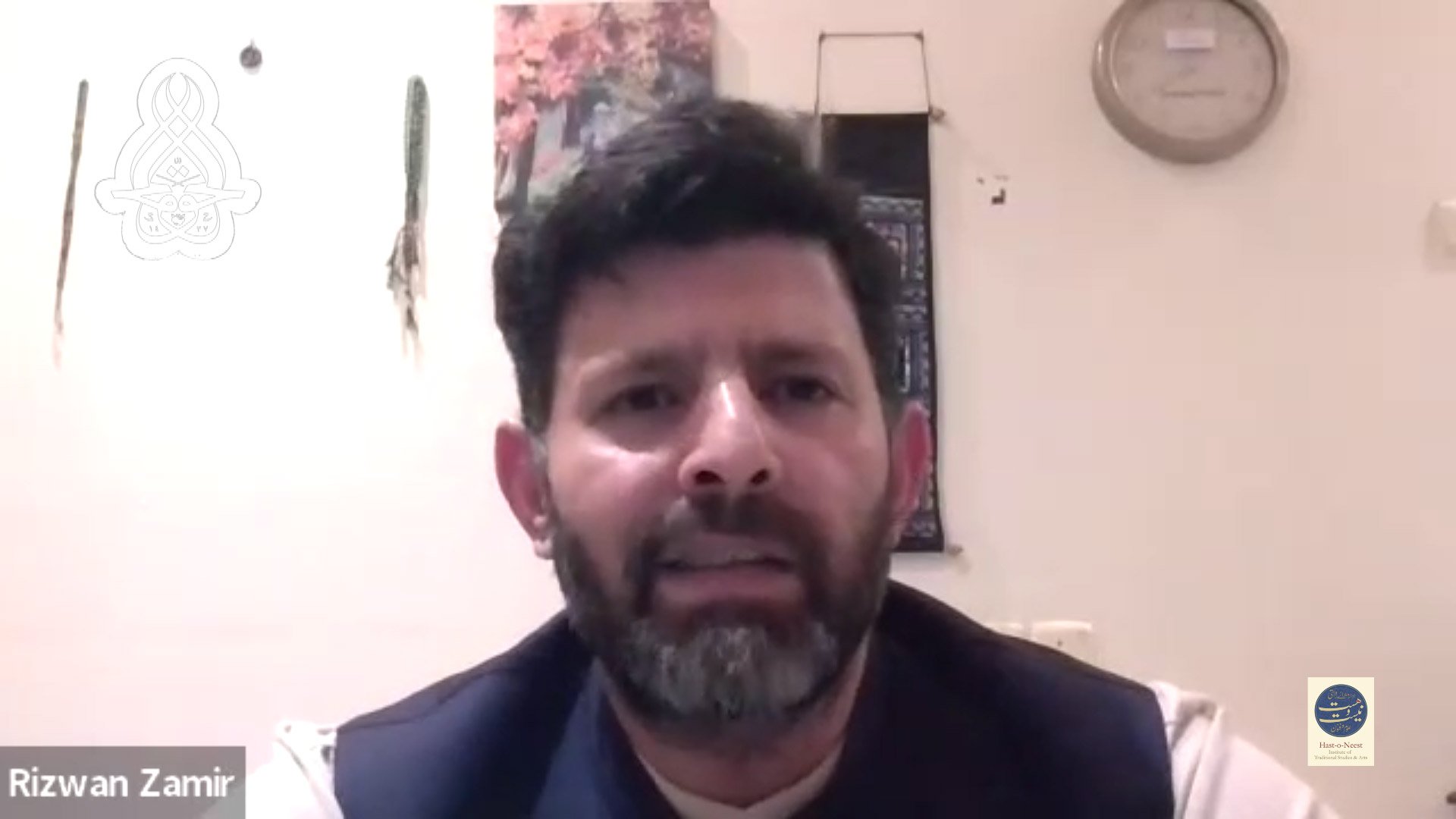
Dr. Syed Rizwan Zamir
Taimoor Khan Mumtaz
5. Quran Majeed Program
پروگرام برأے تعارفی اسباق قرآن مجید Quran Majeed | A One Month Introductory Programme | 2024
The Journey consists of Five Topics spread over a period of 12 sessions in the month of Ramzan ul Mubarak. Sessions are online & in-person five afternoons of the week (excluding weekends).
Responding to the aspirations of urban Pakistanis, educational institutions today largely focus on career goals. Pursuit of knowledge, critical thinking and values become secondary. ‘Religious practice’ is retained only as ritual, which in turn leaves very little space for the study and absorption of the Quran as a living and ever-relevant text. However the Quran holds a centrality in every house as a sacred text and as an intrinsic part of faith.
The Ramzan ul Mubarak Quran Majeed Introductory Program is designed to take the ritualistic relationship with the Quran to a more holistic and intellectual level.
1) Appreciating the language and socio-historical context of the Quranic revelation.
(2) Experiencing the Quran in its visual, auditory & aesthetic dimensions.
(3) Familiarization with the mainstream theological schools and the classical methodologies of interpretation to bring out the contrast with contemporary trends.
(4) Taking cognizance of the layers of meaning and themes of the Quran.
(5) Introducing other aspects of the Quran such as its connection with hadith; methods of transmission; the impact of the Quran on Islamic Culture and Civilization; and its usage as talismanic power, and more.
Course of Study
-
Teacher Profiles
Taimoor Khan Mumtaz: MA PRASADA, Leicester, UK; BArch NCA Lahore. Taimoor Khan Mumtaz practices architecture in Lahore, and teaches metaphysics, geometry and Islamic Architecture at Hastoneest and various other institutes.
Syed Hijaz Mehdi is a poet and teaches Urdu poetry appreciation at Hast o Neest, and other educational forums. He is fluent in Arabic, Farsi and holds a keen interest in philosophy. He has published a collection of his poetry, and a book on Urdu poetics published by Hast o Neest.
Hamid Reza Fazil: A traditional religious scholar of Arabic, Quranic Exegesis and Islamic Law with special interest in philosophy & metaphysics. Listen to a Lecture
Dr. Syed Rizwan Zamir: Ph.D. University of Virginia. B.A . James Madison University. Area of Islamic studies, specializing in Islamic thought and spirituality. He is currently an Associate Professor at Davidson College, NC, USA.
Dr. Amjad Waheed: Ph.D.Comparative Civilizations University of Punjab. Ex - Director School of Advanced Studies, UMT, Lahore.
Dr. Syed Muhammad Rehan-ul-Hasan Gelani Chishti Nizami currently teaches at Minhaj University Lahore.
He has secured Gold Medal in Ash-Shahadatul-Aalamiyyah Fil Uloom Al-Arabiyyah wal-Islamiyyah and 1st Position in BS (Hons) Arabic from Minhaj University Lahore.
He is also Adeeb Arabi and Alim Arabi from Darul-Uloom Muhammadiah Ghosiah, Bhera. His fields of interest include studies on Molana Rumi, Allama Iqbal, Said Nursi, Naat and Ilahiyat (Islamic Philosophy).
-
Program Requirement
The program is suitable for beginners to the subject.
1 | Applicants should be comfortable with Urdu and English language.
2. The emphasis is on reading, reflection & teacher engagement to gain clarity & insight
-
Course Format & Duration:
1) Format: Online on Zoom & In-person
One hour to one & a half hour sessions; five afternoons in a week - Mondays to Fridays; 4:00 to 5:00/5:15-30 pm.
2) Duration: 12 sessions in one month - Ramzan ul Mubarak.
3) Contributing Fee | PKR 6000/-
Details of payment method will be shared after student application.
-
The sessions will be online on Zoom & In person. Recordings of sessions will be provided to all applicants.
-
To Apply: Send in Course Title, Applicant Name, Academic Background, Email Address & Whatsapp number on hast.o.neest@gmail.com or on 03008493170 with a short paragraph on the reason for applying.
Teacher Profiles & Structure